
If you’ve ever looked at a Google Ads campaign that should be working but isn’t, you’ve probably asked this question at some point: Does page speed affect Google Ads?
Short answer: yes.
Longer, more useful answer: page speed quietly influences almost every performance metric that matters in paid search, even though Google doesn’t always spell it out.
At Codevelop, we’ve managed Google Ads accounts where the ads, keywords, and bidding strategy were solid. Clicks were coming in. But conversions? Expensive and inconsistent. Once we dug into landing page speed, things started to make sense.
This page breaks down how page speed affects Google Ads, why it matters more than most advertisers realize, and what you can actually do to fix it based on real campaign work, not theory.
How Page Speed Connects to Google Ads Performance
Google Ads doesn’t exist in isolation. Every click ends somewhere, and that “somewhere” is your landing page. That’s where page speed starts to matter.
From Google’s perspective, ads are only successful if users have a good experience after clicking. That’s why page speed and Google Ads performance are tied together through several indirect but powerful signals.
Here’s what’s happening behind the scenes:
- Google evaluates landing page experience
- Landing page experience feeds into Quality Score
- Quality Score influences cost per click, ad rank, and impression share
So while page speed isn’t a visible Google Ads setting, its impact shows up everywhere.
Google Ads Quality Score and Page Speed: The Overlooked Link
One of the biggest misconceptions is that page speed doesn’t matter because “Quality Score is mostly about keywords and ads.” That’s only partly true.
Quality Score is made up of:
- Expected click-through rate
- Ad relevance
- Landing page experience
Page speed plays directly into the landing page experience.
From real client audits, slow-loading pages tend to:
- Increase bounce rates
- Reduce time on page
- Lower conversion rates
All of those signals tell Google the page isn’t meeting user expectations.
We’ve seen cases where improving load time alone led to:
- Lower Google Ads cost per click
- Higher impression share with the same bids
- Better stability during competitive auctions
That’s the Google Ads page speed impact most advertisers don’t account for when they’re focused only on keywords.
Landing Page Speed and Conversion Rates
Let’s move away from Google’s algorithms for a moment and talk about people.
When someone clicks an ad, they’re usually in decision mode. They want an answer, a price, or a solution right now. If your page hesitates, they don’t wait.
This is where landing page speed and Google Ads performance really show themselves.
Ask yourself:
- Would you wait 6–7 seconds for a page after clicking an ad?
- Would you trust a slow site enough to fill out a form or enter payment info?
In campaign testing across service businesses and ecommerce brands, we consistently see faster pages convert better, even when everything else stays the same.
This is how page load time and Google Ads directly affect ROI.
Mobile Page Speed Matters Even More for Google Ads
Most Google Ads traffic today is mobile-heavy. That changes the equation.
Mobile users:
- Are more impatient
- Often on weaker connections
- Expect instant feedback
A page that feels “okay” on desktop can be painfully slow on mobile. And Google knows it.
This is why mobile page speed and Google Ads performance are such critical factors, especially for:
- Local service ads
- Call-focused campaigns
- High-intent searches near decision time
We’ve audited mobile landing pages that passed desktop speed tests but failed real-world mobile usage. Fixing that gap often improves conversions without touching bids or ad copy.
Core Web Vitals and Google Ads: Are They Connected?
Core Web Vitals are officially an SEO ranking factor, but they also influence paid traffic outcomes.
While core web vitals and Google Ads aren’t directly linked in Google’s documentation, the overlap is real:
- Largest Contentful Paint affects perceived load speed
- Interaction with Next Paint affects usability
- Cumulative Layout Shift affects trust
All three shape how users interact with your landing page after clicking an ad.
From testing multiple setups, pages that pass Core Web Vitals thresholds tend to:
- Hold attention longer
- Reduce accidental bounces
- Improve form completion rates
That’s why performance teams often treat SEO and paid landing pages as a shared responsibility.
If you’re working with a Digital Marketing Agency in Portland, Oregon, this kind of cross-channel optimization is usually where the real gains come from.
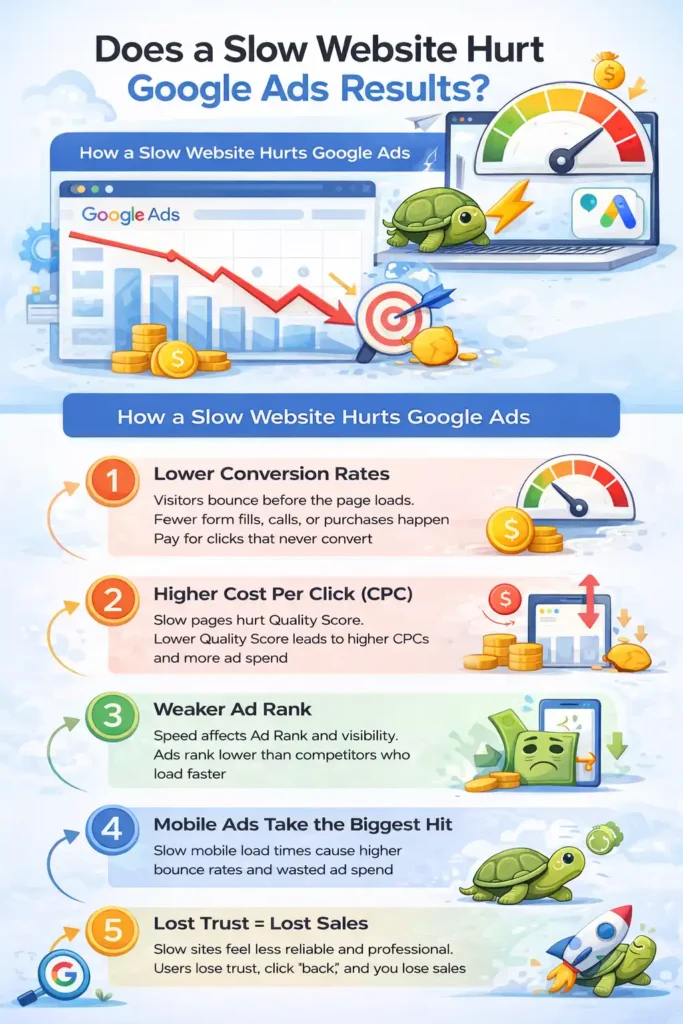
Does a Slow Website Hurt Google Ads Results?
Yes, and usually in ways that aren’t obvious at first.
The slow website effect on Google Ads typically shows up as:
- Rising cost per lead
- Declining conversion rates
- Inconsistent performance week to week
Advertisers often react by:
- Increasing bids
- Expanding keyword lists
- Testing new ad copy
But none of that fixes the root problem.
In several campaigns we’ve reviewed, speeding up the site produced better results than weeks of bid adjustments. That’s because the issue wasn’t traffic; it was friction.
Page Speed’s Impact on Cost Per Click
Here’s a subtle but important point: Google Ads cost per click and page speed aren’t directly related, but it’s a real one.
If your landing page experience is weak:
- Quality Score drops
- Ad Rank suffers
- You pay more to compete
We’ve seen CPCs decrease after speed improvements, even when:
- Keywords stayed the same
- Competition didn’t change
- Budgets remained flat
That’s how Google Ads performance optimization through page speed works in practice.
How Fast Should a Landing Page Be for Google Ads?
There’s no perfect number, but there are practical thresholds.
From campaign testing and analytics reviews:
- Under 2.5 seconds: ideal
- 2.5–4 seconds: workable but risky
- Over 4 seconds: performance usually drops fast
This applies even more strongly to mobile traffic.
If you’re running ads to custom-built pages, whether on WordPress, Shopify, or Webflow, the underlying platform and build quality matter. A well-structured site from a Web Development Services in Portland team can make optimization far easier.
Tools That Actually Help With Google Ads Page Speed
Tools are only useful if you know what to look for. In audits, these tend to matter most:
- Google PageSpeed Insights – Shows real performance data tied to Core Web Vitals
- Chrome DevTools – Useful for identifying render-blocking issues
- GA4 + Google Ads – Helps correlate load time with conversion behavior
What matters isn’t the score, it’s what’s slowing the page down:
- Heavy images
- Third-party scripts
- Unoptimized themes or builders
- Excessive tracking pixels
Speed optimization isn’t just technical. It’s strategic.
Page Speed Optimization for Paid Ads: What Actually Works
Here’s what consistently improves website speed for Google Ads campaigns:
1. Use Dedicated Landing Pages
Sending paid traffic to generic service pages is usually slower and less focused.
2. Optimize Images Aggressively
Large images are one of the biggest performance killers in paid campaigns.
3. Reduce Script Bloat
Every extra chat widget, heatmap, or tracker adds load time.
4. Choose the Right Platform
Different platforms handle speed differently:
- Webflow tends to perform well out of the box
- Shopify needs careful app management
- WordPress requires solid hosting and optimization
That’s why teams offering Google Ads Management in Portland, Oregon, often work closely with developers.
How Page Speed Affects Ad Conversions
This is where everything comes together.
How page speed affects ad conversions isn’t theoretical. It shows up in:
- Form completion rates
- Scroll depth
- Button clicks
- Revenue per visit
In ecommerce campaigns, faster pages almost always improve:
- Add-to-cart rates
- Checkout completion
- Return visitor performance
In lead-gen campaigns, speed impacts:
- Trust
- Perceived professionalism
- Willingness to submit personal information
You can’t separate conversion psychology from performance.
FAQs
Does page speed directly affect Google Ads Quality Score?
Not directly, but it strongly influences landing page experience, which affects Quality Score.
Can a slow landing page increase Google Ads CPC?
Yes. Poor landing page experience can lower Quality Score, leading to higher CPCs.
Does page speed matter more for mobile Google Ads?
Absolutely. Mobile users are less patient, and Google evaluates mobile experience closely.
Are Core Web Vitals required for Google Ads success?
They’re not required, but pages that meet Core Web Vitals standards usually perform better.
Should I prioritize page speed over ad copy testing?
If your page is slow, improving speed often delivers bigger gains than ad copy tweaks.
Where Page Speed Fits Into a Bigger Marketing Strategy
Does page speed directly affect Google Ads Quality Score?
Not directly, but it strongly influences landing page experience, which affects Quality Score.
Can a slow landing page increase Google Ads CPC?
Yes. Poor landing page experience can lower Quality Score, leading to higher CPCs.
Does page speed matter more for mobile Google Ads?
Absolutely. Mobile users are less patient, and Google evaluates mobile experience closely.
Are Core Web Vitals required for Google Ads success?
They’re not required, but pages that meet Core Web Vitals standards usually perform better.
Should I prioritize page speed over ad copy testing?
If your page is slow, improving speed often delivers bigger gains than ad copy tweaks.
Page speed shouldn’t be treated as a one-off fix. It’s part of a broader performance ecosystem that includes:
- Paid search
- SEO
- UX design
- Conversion optimization
That’s why agencies offering Performance Marketing Agency in Portland services often start with technical audits before scaling spend.
Fast pages don’t just help Google Ads; they make everything work better.
Final Thoughts: Does Page Speed Affect Google Ads?
Yes, more than most advertisers expect.
Page speed affects:
- Landing page experience
- Conversion rates
- Cost per click
- Campaign stability
And unlike bidding strategies or keyword trends, speed improvements tend to compound over time.
If you’re investing in ads, it’s worth treating speed as part of your paid strategy, not just a technical detail. In real-world campaigns, that mindset shift is often the difference between “okay” results and consistent, profitable growth.
